Description
The St. Elizabeth Hungarian Roman Catholic Parish in Toronto is one of the most significant and enduring institutions of the Hungarian Catholic diaspora in Canada. Its history dates back to the mid-1920s, when there was a growing demand among Hungarian Catholics living in Toronto for pastoral care, education, and community life in their native language. In 1926, Dr. István Leskó founded the Catholic Circle, which became the most important lay driving force behind the organization of the future parish.
The parish was officially established in 1928, following a decree by Archbishop MacGuigan of Toronto. At that time, the community did not yet have its own church, so the first Hungarian Masses were held in various Toronto churches: the Carmelite church on Ossington Street, the Lithuanian St. John’s Church at the corner of Dundas and Grace Streets, and the chapel of St. Michael’s Cathedral. These temporary locations clearly illustrate the community’s initial vulnerability, but also its organizational strength.
In 1929, the Catholic Circle rented the large hall of the house at 147 Beverly Street, which served as a clubhouse, meeting place, and English language teaching center. For Hungarian immigrants, mastering the English language was one of the most important prerequisites for social integration. In 1930, Hungarian-language instruction also began at 210 Beverly Street, which later became one of the parish’s most enduring ministries. The Altar Society was founded that same year; it continued as the Women’s Society from 1937 and as the Women’s Association from 1950, and for decades played a defining role in the parish’s religious, charitable, and community life.
After the community’s difficult early years, a significant turning point occurred in 1939: in the person of Fr. Leo Austin, the parish received its first permanent pastor. Father Austin served the Hungarian Catholics of Toronto until 1949. During his tenure, the parish’s organizational life was strengthened, and it became possible to acquire its first church. In 1942, the Society of the Social Sisters also joined the community and educational services, further strengthening Hungarian-language education and social work.
The parish’s first church was consecrated in 1944 on Dundas Street, in the former St. Philip’s Anglican Church building. This event was a milestone in the history of the Hungarian community in Toronto, as it marked the first time the community had its own permanent religious center. After World War II, new Hungarian immigrants arrived in Canada, further increasing the parish’s significance. In 1948, Cardinal József Mindszenty visited the community for the first time. That same year, the Hungarian School and Kindergarten was established, which became one of the most important institutions for the transmission of the Hungarian language, culture, and traditions.
In 1949, a new era began in the life of the parish. With the appointment of Fr. István Békési, SJ, as parish priest, the Jesuits took on the pastoral care of Toronto’s Hungarian Catholics. From that point on, the parish became permanently Hungarian-speaking. In the same year, the Society of the Holy Name was founded, which continued to operate as the Catholic Men’s Association from 1967 onward, and the Married Couples’ Club was also established. Also in 1949, the 20th Árpád Vezér Scout Troop was formed, which became more closely affiliated with the parish starting in 1958.
In the early 1950s, under Jesuit leadership, St. Elizabeth Hungarian School grew into a large institution. In 1951, the community purchased the house at 519 Dundas Street West for parish use. The 33rd Erzsébet Szilágyi Girl Scout Troop was active between 1952 and 1955. In 1955, the church received new stained-glass windows, and a fundraising campaign began to purchase an organ. During the same period, between 1955 and 1966, the community purchased Mindszenty Park in Streetsville and used it for youth activities.
After the suppression of the 1956 Hungarian Revolution, Toronto became one of the major Canadian hubs for Hungarian refugees. St. Elizabeth Parish served as a relief center: it welcomed, assisted, and supported the new arrivals. Members of the Society of the Sacred Heart and the Kalocsa School Sisters also joined in serving the community at this time. In 1957, the St. Elizabeth Choir was formed through the revival of the former St. Cecilia Choir. In 1958, the Credit Union was established, which operated until 2003 and, during its existence, provided loans to more than a thousand families to help them start a new life. In 1959, the 42nd St. Kinga Girl Scout Troop was formed.
The 1960s brought further expansion of community and cultural life. In 1960, the Kodály Ensemble was formed, which functioned as both an orchestra and a dance troupe. In 1961, the Hungarian School, located at 263 Spadina Avenue, expanded, and the Altar Server Club was established. In 1962, the Jesuits purchased Loyola Park in Oron, which later became an important venue for Hungarian youth and Scouting activities. In 1964, the Congregation of Mary for Girls and Women was founded. In 1969, the new parish building was completed, providing a larger space for community programs, education, and pastoral work.
In 1973, Cardinal József Mindszenty visited the parish for the second time. This event once again strengthened the bond between the Hungarian Catholic community in Toronto and the Hungarian church life of the emigrant community. A charismatic prayer group was also formed that same year. In 1975, Loyola Park hosted the Scout Jubilee Camp, which was followed by additional camps in 1980 and 1985.
In 1978, the Hungarian Jesuit novitiate was established in Toronto, which was a significant development not only for the local parish but also for the Hungarian Jesuit presence in North America. That same year, the church received a new pipe organ. In 1980, the Parish Council and the Teachers’ Theater Troupe were formed. In 1981, the Caritas group was established, which first took on the role of assisting Vietnamese refugees and later Hungarian refugees.
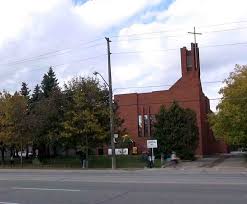
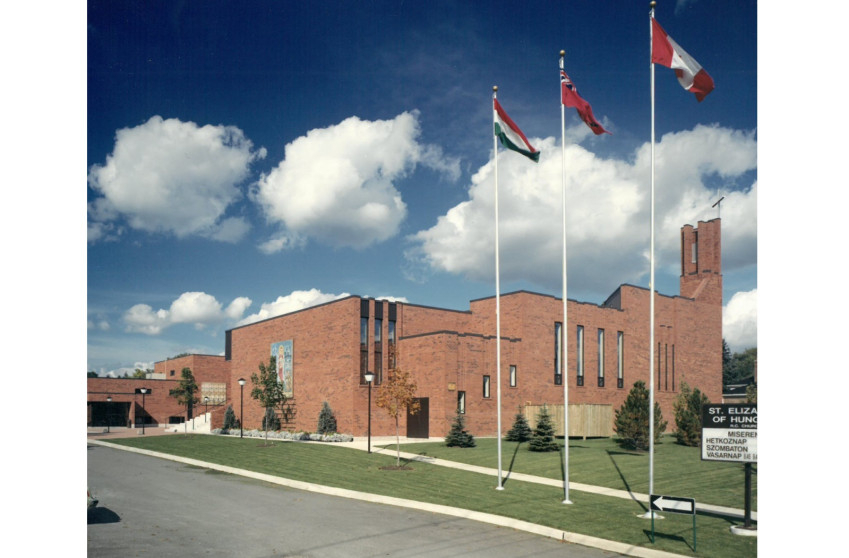
One of the most important milestones in the parish’s dynamic growth was the construction of the new church. In 1984–1985, the current St. Elizabeth Church was completed near Sheppard Avenue and Bayview Avenue. The new church and community center provided a fitting home for Hungarian Catholic life in Toronto and became one of the city’s most important Hungarian institutions.
In the late 1980s, new spiritual and community movements emerged. In 1989, the Cursillo movement and Pax Romana began their activities. That same year, the Hungarian School joined the Separate School Board, and in 1991, the Catholic School Board. In 1993, the Youth Center was expanded with the addition of a third floor, and in 1996, the Seniors’ Club was established, becoming an important hub for the community life of the older generation.
In the 21st century, the parish faced new challenges but remained one of the centers of Toronto’s Hungarian Catholic community. In 2016, due to renovation work, the Hungarian School and the Scouting program temporarily moved out of the parish. During the 2017–2018 jubilee year, the community defined its mission, vision, and future tasks. The basement was renovated so that the Hungarian School and the Scouting program could return, and the parking lot and the entire courtyard were repaved. In 2018–2019, the Hungarian School and the Scouting program returned to the parish community, and the implementation of the pastoral plan began, resulting in an increase in membership and a rejuvenation of the community.
The period from 2020 to 2022 was defined by the lockdowns and restrictions of the COVID-19 pandemic. For more than two years, the community could only operate in a limited capacity, and at times not at all in its usual form. At the same time, the church’s roof insulation and new roofing were completed during this period. In 2022–2023, the community worked on rebuilding itself by rethinking and reorganizing its programs.
The history of St. Elizabeth’s Hungarian Roman Catholic Parish in Toronto clearly illustrates that Hungarian Catholic communities in North America were not merely religious institutions, but also centers for culture, education, social, and centers for preserving national identity. The parish evolved from its initial, temporary places of worship and rented club rooms into a large, institutionally organized community with a school, a scouting program, a choir, charitable organizations, and spiritual movements. It has served the Hungarian community in Toronto and Canada for several generations and remains one of the most important pastoral and community centers for the Hungarian Catholic diaspora.